


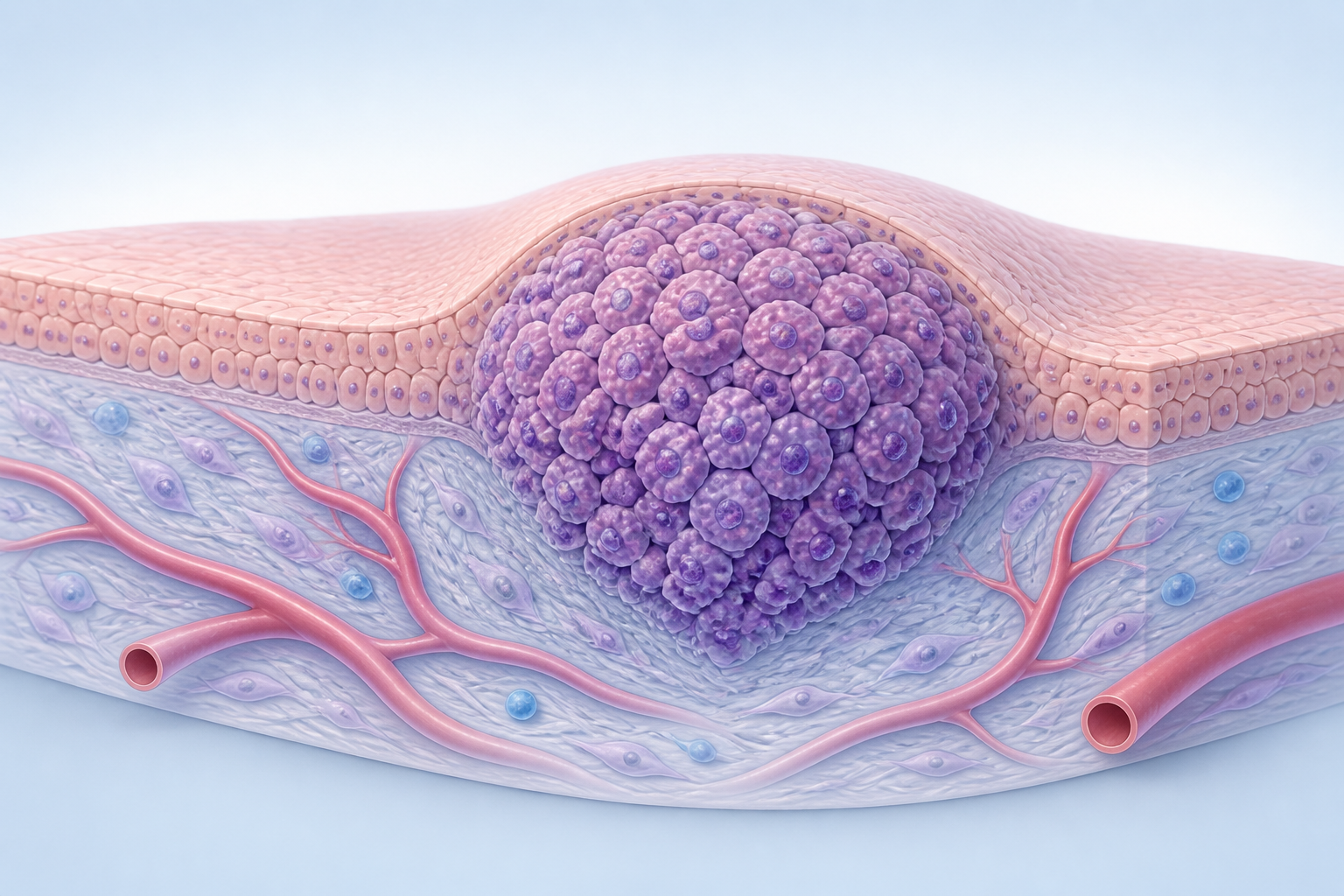
A solid tumor is an abnormal mass of tissue. It develops when cells grow, divide, or survive in ways that are not normally controlled by the body. Solid tumors can form in many organs and tissues, including the breast, lung, prostate, colon, brain, bone, muscle, and skin. The term describes the physical form of the growth; it does not by itself tell you whether the tumor is cancer.
Are all solid tumors cancer?
No. A solid tumor may be benign, meaning it is not cancer, or malignant, meaning it is cancer. Benign tumors do not invade nearby tissue or spread to distant parts of the body, although their size or location can still cause medical problems. Malignant tumors can invade surrounding tissue and may spread through the blood or lymph system. That spread is called metastasis.
Solid tumors are different from cancers that primarily involve blood-forming tissues. Leukemias generally do not form a solid mass. Lymphomas can produce masses, but they arise from cells of the immune and lymphatic systems and are evaluated according to their specific disease type.
How are solid tumors classified?
Doctors classify a tumor by where it began, the type of cell involved, and the features seen in laboratory testing. A carcinoma begins in skin or in tissue lining or covering organs. A sarcoma begins in bone or connective tissues such as muscle, fat, cartilage, or blood vessels. Other solid tumors arise in the brain, nervous system, or specialized tissues.
A pathology report may describe the tumor's type, grade, biomarkers, and other molecular features. Grade describes how normal or abnormal the cells look under a microscope and can provide information about how aggressively the tumor may behave. Grade is not the same as stage.

How is a solid tumor diagnosed?
Evaluation depends on the location and the person's symptoms and history. It may include a physical examination, blood or urine tests, imaging such as CT, MRI, ultrasound, x-ray, or PET scans, and a biopsy. During a biopsy, a clinician removes a sample of tissue so a pathologist can examine it. A biopsy is often needed to determine whether a mass is cancer and to identify the exact tumor type.
An imaging result or abnormal laboratory value alone does not always establish a cancer diagnosis. Your treating clinician is the appropriate person to interpret results in the context of your complete medical history.
What do stage and biomarkers mean?
If a tumor is malignant, doctors may determine its stage. Stage describes the extent of the cancer, including factors such as the size and location of the primary tumor, whether nearby lymph nodes are involved, and whether the cancer has spread elsewhere. Many solid tumors use the TNM system: T refers to the primary tumor, N to nearby lymph nodes, and M to metastasis. Staging systems vary by cancer type.
Biomarker or molecular testing looks for features in the tumor or blood that may help clarify the diagnosis, estimate how the disease may behave, identify treatment options, or determine whether a clinical trial may be relevant. Not every test is appropriate for every tumor.
Solid tumors and clinical trials
Clinical trials may study new drugs, combinations, procedures, devices, radiation approaches, supportive care, screening, or methods of diagnosis. A study may accept one tumor type, several tumor types that share a biomarker, or people at a particular stage of disease. Eligibility can also depend on prior treatments, laboratory results, organ function, age, current health, and other protocol requirements.
Being interested in a trial does not mean that enrollment is automatic or that an investigational treatment is proven to work. Screening confirms whether a person meets the study criteria. The informed-consent process should explain the study's purpose, procedures, schedule, potential risks and benefits, alternatives, privacy protections, costs, and whom to contact. Participation is voluntary.
Questions to ask the research team
- What is the exact tumor type, stage, and grade?
- Is biomarker testing needed for this study?
- What treatments or procedures are being studied?
- Which visits, scans, biopsies, or blood tests are required?
- What are the known and possible risks and benefits?
- What standard treatment options are available outside the trial?
- Which costs are covered by the study, insurance, or the participant?
- Who should be contacted about symptoms or urgent concerns?
Reliable sources
- National Cancer Institute: Solid tumor definition
- National Cancer Institute: How cancer is diagnosed
- National Cancer Institute: Cancer staging
This article provides general educational information and is not medical advice, a diagnosis, or a statement that a specific study is available. Talk with your healthcare professional and the research team about your individual situation. For a medical emergency, call 911.